
On 22 September 2026, Computer Weekly turns 60. To mark the milestone, we asked some of our friends – experts, parliamentarians, IT leaders and suppliers – for their perspectives on how tech has changed their lives over six decades. What’s changed the most for you since then?
In 1990, a lecturer stood before a room of Cambridge computer science students and made a bold claim – there was no money in hardware. In the future, he insisted, all the value would live in software.
We laughed.
To us, it sounded absurd. In 1990, a high-end PC cost close to £4,000, a fortune that dwarfed my entire PhD student grant. Back then, you paid for the physical machine – the software was thrown in for free to make the hardware useful. The value was clearly in the silicon you could hold in your hand. Everyone in that room “knew” that. So, we laughed.
The lecturer wasn’t just anyone, though. It was Sir Andy Hopper, co-founder of Acorn Computers and one of Britain’s most accomplished computer scientists. He stood out because he combined deep technical expertise with sharp business acumen.
And he, of course, was completely right. Within a decade, hardware became a commodity, software “ate the world,” and the tech industry minted the largest fortunes in human history.
The rarest skill in tech: reasoning forward
I have thought about that lecture more than any other moment in my career.
Hopper wasn’t just guessing – he was reasoning forward from visible trends. He valued where the future was going rather than where the present was stuck. While the rest of us were staring at the price tag of a 1990 PC, Hopper was already living in the next Millenium.
This is the rarest skill in technology. It’s not just about invention or engineering brilliance. The real superpower is seeing where the world is headed clearly enough to align your life with it before anyone else agrees with you, and of being willing to look foolish in the meantime.
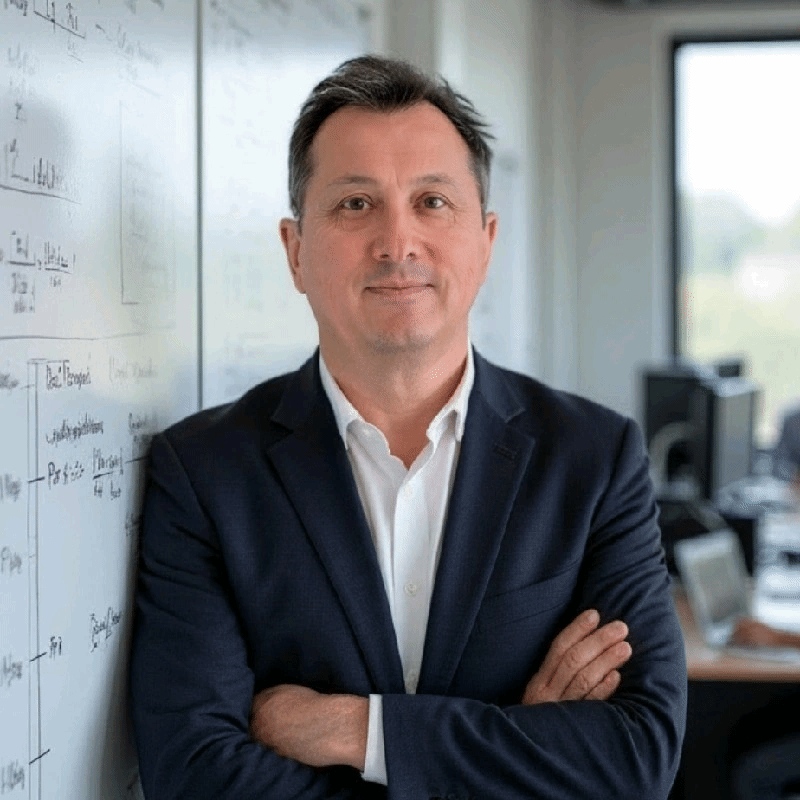
“Each [technological] migration looked completely absurd at the start. Each looked blindingly obvious at the end. The whole game of technology is learning to lean into the direction of travel early”
Stephen Hodges
After finishing my PhD, I chose to work for Hopper as a research engineer at the Olivetti Research Laboratory (ORL). My logic was simple – why not work for the person who can see the future?
ORL was an extraordinary place. We built technologies that made little sense at the time, but made perfect sense once the world caught up to the trends we were riding – the asynchronous transfer mode networking, which went on to carry the world’s telecommunications traffic; virtual network computing, which still underpins how we access screens remotely today; Piconet, a low-power wireless network built years before Bluetooth made the concept ubiquitous; or the broadband phone, which was an early attempt at carrying voice over the internet, long before the term “VoIP” even existed.
None of this felt inevitable when we were building it. It only looks obvious in hindsight. That was the ultimate lesson – reason forward from where technology is heading and build for the world it will inevitably create.
The collapsing cost of intelligence
Generative AI is disrupting every industry built on the assumption that intelligence is rare and expensive. By turning this assumption on its head, it forces us to reimagine healthcare, financial services, and education under a radical new premise – what happens when the cost of intelligence approaches zero?
Today, I run Efekta Education, where we are using generative AI as the fundamental building block to reinvent how the world learns.
People often ask if AI in the classroom is just hype, but they are asking the wrong question. The right question, and the one Andy Hopper would have asked, is: where is this heading? Just as the cost of computing once plummeted, the cost of one-to-one teaching is collapsing right now.
We believe every academic institution must radically rethink how it teaches and supports students in an AI-enabled world. Why? Because it works. Forty years ago, educational psychologist Benjamin Bloom proved that a child taught one-to-one learns dramatically faster than one lost in a class of 30.
For most of human history, personalised tutoring has been a privilege reserved for the wealthy few. When you give every child the kind of personal tutor only the rich could once afford, you don’t simply raise a test score, you change what a country can become.
We are betting big on that future, exactly as Andy Hopper taught us.
We are working with governments to transform public education at scale, focusing first on countries with the most to gain – those facing massive teacher shortages. Roughly four million students now learn with Efekta.
I cannot imagine more meaningful work.
The digital revolution is ultimately a single, continuous story of value migrating from one domain to the next: mainframe – PC – software – network – data – intelligence.
Each migration looked completely absurd at the start. Each looked blindingly obvious at the end. The whole game of technology is learning to lean into the direction of travel early.
I owe Andy Hopper a great deal. He taught a lecture theatre full of sceptics how to reason forward, and it remains the most valuable technology lesson I have ever received.
Stephen Hodges is chief executive officer of Efekta Education.
