
TL;DR
- License and Access: Inkling carries Apache 2.0 terms, while Thinking Machines Lab plans to publish Inkling-Small’s weights after testing.
- Sparse Design: The 975-billion-parameter model activates 41 billion parameters per token through a DeepSeek-V3-inspired mixture-of-experts architecture.
- Hardware Floor: Inkling’s 16-bit weights need a minimum of 2 TB of GPU memory, while a lower-precision version needs 600 GB.
- Adoption Test: Mixed benchmark results, paid Tinker fine-tuning and managed hosting will shape Inkling’s practical uptake.
Thinking Machines Lab released Inkling on July 15 under the Apache 2.0 license after using Kimi K2.5 for early post-training data. Open weights let developers download and adapt the trained parameters, while the training data and complete development process remain private.
Inkling has 975 billion total and 41 billion active parameters for each token. Its scale gives U.S. developers another large model they can customize, although the design openly follows DeepSeek-V3.
Inkling’s mixture-of-experts architecture routes each token through six of 256 experts, alongside two shared experts, rather than activating the full network. Selective routing cuts the computation used per token and explains how a model with 975 billion total parameters uses a much smaller active set. DeepSeek introduced the predecessor architecture in late 2024.
What Inkling Requires to Run and Customize
Sparse routing does not remove the hardware barrier. Inkling’s full 16-bit checkpoint requires a GPU cluster with a minimum of 2 TB of aggregate GPU memory, equivalent to eight Nvidia B300 graphics processing units or 16 H200 units. A lower-precision edition cuts the minimum to 600 GB and can run on four B300 or eight H200 units, reducing memory demand without establishing identical accuracy.
Local operation still requires an inference deployment framework such as SGLang, vLLM, TokenSpeed, Unsloth or Hugging Face, adding software integration work to the hardware bill. Even the smaller footprint remains beyond a typical workstation, leaving self-hosting to organizations with costly multi-accelerator systems.
Inkling accepts text, image and audio as inputs but returns only text for coding, tool use and retrieval-augmented generation systems. Thinking Machines Lab trained Inkling from scratch on Nvidia GB300 NVL72 systems using 45 trillion training tokens spanning text, images, audio and video, but training scale does not guarantee reliable answers.
Developers can download the weights from Hugging Face, fine-tune Inkling through Thinking Machines Lab’s paid Tinker platform, or use Inkling Playground. Databricks made the model available through Unity AI Gateway for enterprise data, agent and coding workflows, while third-party inference providers offer another path for teams without local hardware. Downloading the weights gives adopters more control, whereas managed access changes who operates the accelerators without reducing Inkling’s underlying memory demand.
Customizing Inkling required specialist machine-learning skills, with adopters retaining responsibility for safeguards on their adaptations. Thinking Machines Lab positions Inkling as a customizable multimodal base rather than the strongest model available overall. Apache 2.0 lowers legal barriers to adaptation, but practical value will depend on whether that control justifies the hardware and specialist labor.
Mixed Benchmarks in a Crowded Open-Weight Field
Inkling scored 41 points on Artificial Analysis’ Intelligence Index, a third-party composite benchmark, compared with 38 for Nvidia Nemotron 3 Ultra among the cited U.S. models.
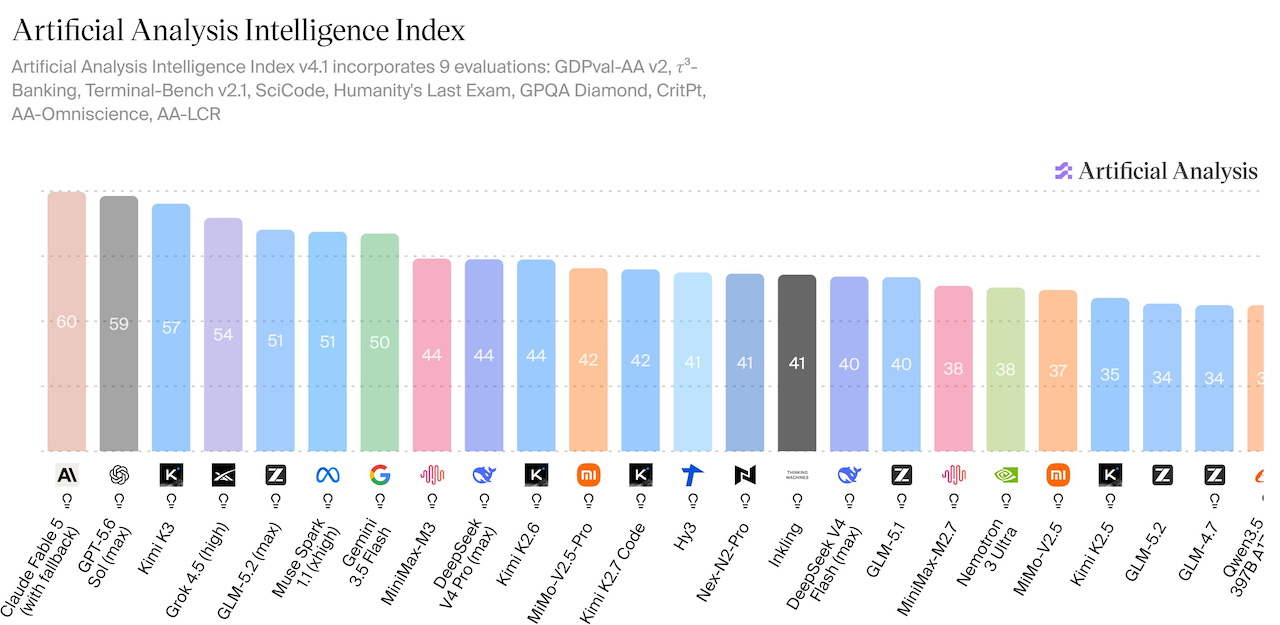
On AA Omniscience, a separate factual-accuracy and hallucination evaluation, Inkling recorded 40 percent accuracy and a 63 percent hallucination rate. Because the tests measure different capabilities, neither establishes overall quality.

Tobias Mann, systems editor at The Register, cautioned: “Take these claims with a grain of salt — gaming AI benchmarks isn’t exactly difficult”.
Chinese models remain relevant as benchmark comparators. Z.AI’s GLM-5.2 currently leads the open-weight ranking.
Kimi K2.5 contributed limited training data to Inkling before the majority of later work shifted to large-scale reinforcement learning.
Inkling-Small is also in preview with 276 billion total parameters and 12 billion active parameters. SO far developers cannot download Inkling-Small until Thinking Machines Lab completes testing and releases its weights.
