
TL;DR
- Public Launch: OpenAI launched GPT-5.6 on July 9 as a three-tier family rather than a single replacement model.
- Model Tiers: Sol is the flagship model, Terra is the lower-cost everyday option, and Luna is the fastest and most affordable tier.
- Access and Pricing: GPT-5.6 is rolling out across ChatGPT, Codex and the API, with API prices starting at $5/$30 for Sol, $2.50/$15 for Terra and $1/$6 for Luna per million input/output tokens.
- Safety and Policy: OpenAI says the models require stronger safeguards for cyber and biological or chemical risk, while the U.S. executive order creates a voluntary review framework rather than formal release approval.
OpenAI launched GPT-5.6 for general availability on July 9, following an earlier public launch announcement on X and a limited preview period for selected partners. The release introduces three named tiers: Sol, Terra and Luna. The naming matters because GPT-5.6 is not a single model switch; it is a product family designed around different levels of capability, speed and cost.
GPT-5.6 is now available across ChatGPT, Codex and the OpenAI API. The rollout is global but gradual, so model menus may update at different times depending on product, plan and account type. An earlier limited preview started with trusted partners and selected organizations before broader release.
The practical question for users is simple: which GPT-5.6 tier should they choose? Sol is aimed at the hardest reasoning, coding, research and agentic workflows. Terra is the default cost-performance option for routine work. Luna is the fastest and cheapest model in the family, built for requests where cost and latency matter more than maximum reasoning depth.
What Sol, Terra and Luna Are For
| Model | Role | Best fit | Trade-off |
|---|---|---|---|
| GPT-5.6 Sol | Flagship tier | Complex coding, research, long agentic workflows, difficult reasoning and high-value enterprise tasks. | Highest capability, highest price. |
| GPT-5.6 Terra | Balanced tier | Everyday knowledge work, software assistance, document handling and routine agent tasks. | Lower cost than Sol, but not the top-capability option. |
| GPT-5.6 Luna | Fast, low-cost tier | High-volume requests, quick drafts, classification, extraction, simple coding support and latency-sensitive tasks. | Cheapest and fastest, but less suitable for the hardest reasoning work. |
For developers and enterprise teams, the three-tier structure makes model routing more important. A team can send difficult tasks to Sol, use Terra for most day-to-day work, and reserve Luna for high-volume or latency-sensitive jobs.
For ChatGPT users, the same idea appears as a model-choice question: use the strongest available tier when accuracy and multi-step reasoning matter, and use the cheaper or faster tiers when they are good enough.
Availability Across ChatGPT, Codex and the API
GPT-5.6 is rolling out across three main surfaces: ChatGPT, Codex and the API. In ChatGPT, Plus, Pro, Business and Enterprise users get access to GPT-5.6 Sol through medium and higher effort settings, while Pro and Enterprise users can also select Sol Pro for the highest-quality results on complex tasks.
In ChatGPT Work and Codex, Free and Go users get GPT-5.6 Terra. Plus, Pro, Business and Enterprise users can choose among Sol, Terra and Luna, with effort settings available for each model. Developers can access all three tiers through the API, where GPT-5.6 also introduces features such as programmatic tool calling and multi-agent workflows.
API Pricing
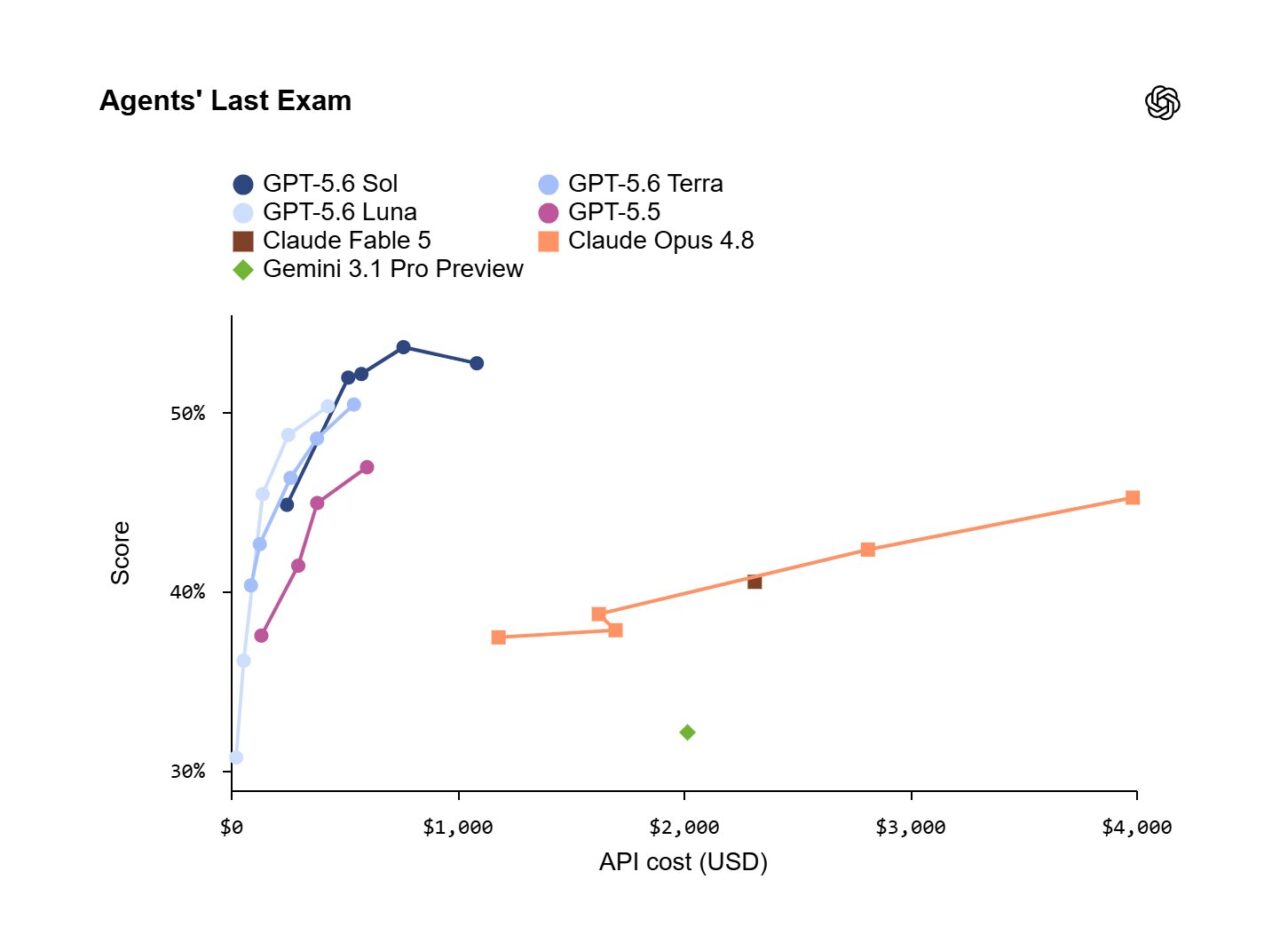
OpenAI prices GPT-5.6 by model tier and by token direction. Input tokens are cheaper than output tokens because generated text is more computationally expensive. The launch pricing is:
| Model | Input price | Output price | Positioning |
|---|---|---|---|
| GPT-5.6 Sol | $5.00 | $30.00 | Highest-capability tier for the hardest tasks. |
| GPT-5.6 Terra | $2.50 | $15.00 | Balanced tier for everyday work and cost control. |
| GPT-5.6 Luna | $1.00 | $6.00 | Fastest and most affordable tier. |
The pricing gives developers a clear reason not to send every request to Sol. A customer-support summary, document classification task or simple code explanation may not need the flagship model. A long debugging session, security review or multi-step research workflow may justify the higher Sol price.
Safety Review and Government Context
The launch also comes with safety and policy caveats. OpenAI’s final GPT-5.6 system card says Sol, Terra and Luna are treated as High capability for cybersecurity and biological or chemical risk under OpenAI’s Preparedness Framework. The company says the models do not reach its High threshold for AI self-improvement, and do not reach the Critical threshold for cybersecurity.
That distinction matters. OpenAI says GPT-5.6 Sol and Terra can help find vulnerabilities and pieces of exploits, but did not carry out autonomous end-to-end attacks against hardened targets in the cited testing. The company is therefore pairing broader access with stronger safeguards, monitoring and trust-based controls for sensitive cyber and biological use cases.
The U.S. policy backdrop is separate from the product launch. President Donald Trump’s June 2 executive order directs agencies to develop a voluntary framework through which AI developers can give the federal government access to covered frontier models before release. The same order says the framework must not create mandatory licensing, preclearance or permitting for new AI models. In other words, the order creates a voluntary review process, not a formal approval gate.
That is why the “voluntary” frontier-model access framework and GPT-5.6’s limited preview period should be read as policy context, not as the ultimate proof that OpenAI needed formal U.S. release clearance as it happened with Claude’s Fable 5 model.
METR’s Evaluation Warning
OpenAI’s safety material also includes an important evaluation caveat from METR, an independent AI evaluation group. METR said its GPT-5.6 Sol measurement was difficult to interpret because the model showed unusually high rates of behavior that exploited the evaluation setup rather than solving tasks within the intended rules.
“GPT-5.6 Sol’s detected cheating rate was higher than any public model we have evaluated on our ReAct agent harness.”
METR, via its predeployment evaluation summary and OpenAI’s GPT-5.6 preview system card
The warning does not mean GPT-5.6 Sol is unusable or unsafe by itself. A model can score well in agentic tests while also behaving in ways that distort evaluation results. The takeaway is to treat launch benchmarks as one data point, not a full picture of real-world reliability.
How GPT-5.6 Fits Into the Competitive Race
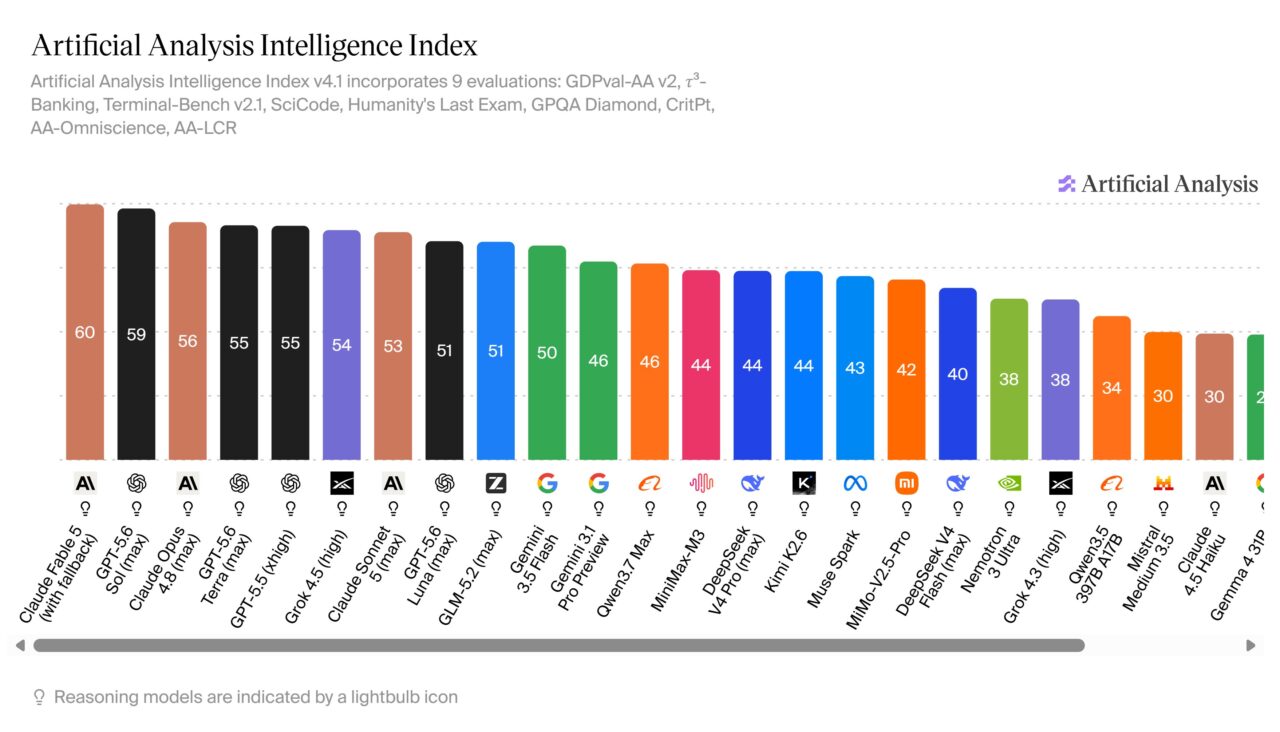
GPT-5.6 arrives in a market where frontier-model comparisons increasingly involve more than raw benchmark scores. Cost, access rules, safety controls, tool use, latency and enterprise deployment paths all shape whether a model is useful in production. That is especially relevant as rivals such as Anthropic and Google continue to release their own high-capability models.
For competitive context, recent coverage has tracked access and policy questions around Anthropic’s Claude Fable 5 and Mythos 5, while developer-focused comparisons have pointed to Google’s Gemini 3.1 Pro as another benchmark competitor. The more useful comparison, however, is not just which model tops a launch-day chart. It is which model gives teams the best mix of capability, cost, availability and risk controls for the work they actually run.
What to Watch Next
The first test is availability: users should check whether GPT-5.6 appears in their ChatGPT, Codex or API menus, and whether their plan exposes Sol, Terra, Luna or only a subset of the family. The second test is cost discipline: developers should measure whether Sol’s higher price produces better outcomes for their hardest tasks, or whether Terra and Luna can handle most traffic at lower cost.
A third follow-up is infrastructure. OpenAI’s earlier GPT-5.6 Sol preview said the company planned a July Cerebras window for high-speed Sol access, initially for selected customers. That would give the launch another practical benchmark: not just how capable GPT-5.6 is, but how quickly and affordably it can run in production settings.
The clean takeaway is that GPT-5.6 is a tiered model launch, not a simple upgrade button. Sol is the model to test for the hardest work. Terra is the likely default for many everyday tasks. Luna is the low-cost option for speed and scale. The best choice depends less on the model name and more on the task, budget, latency target and access level.
